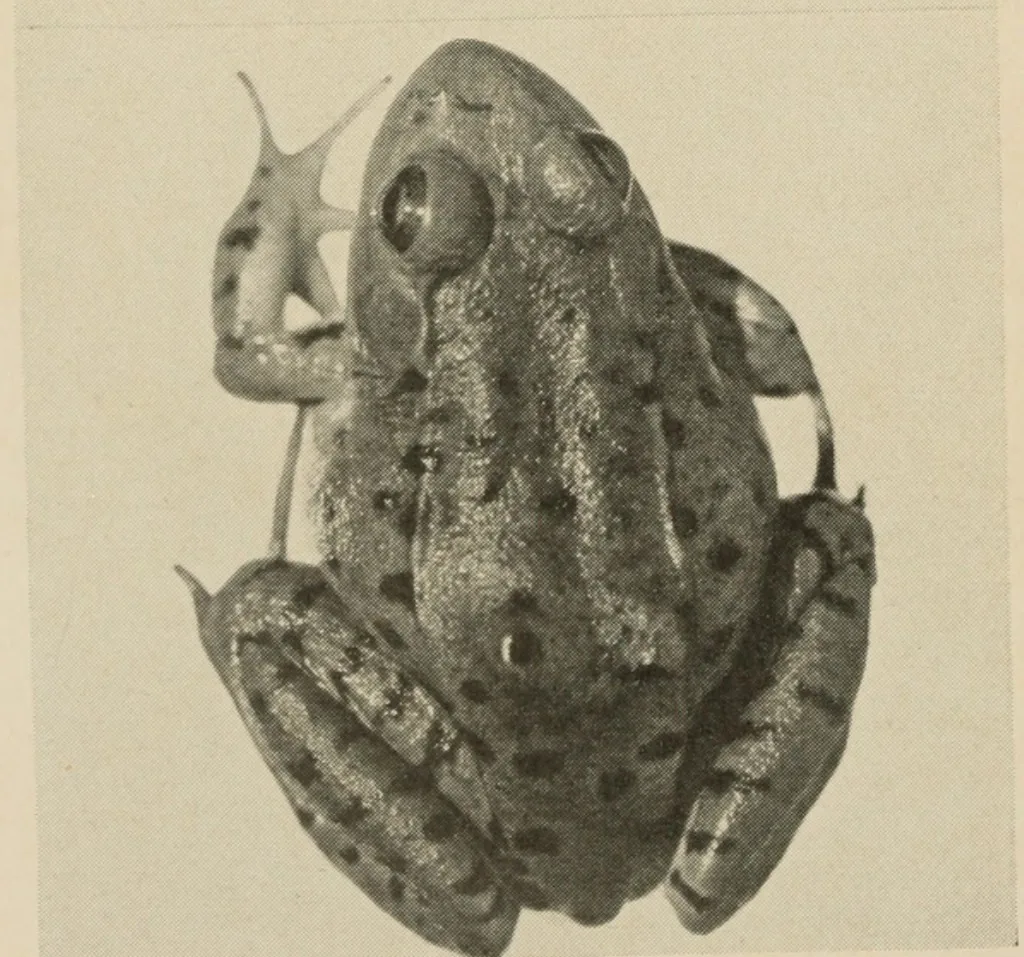
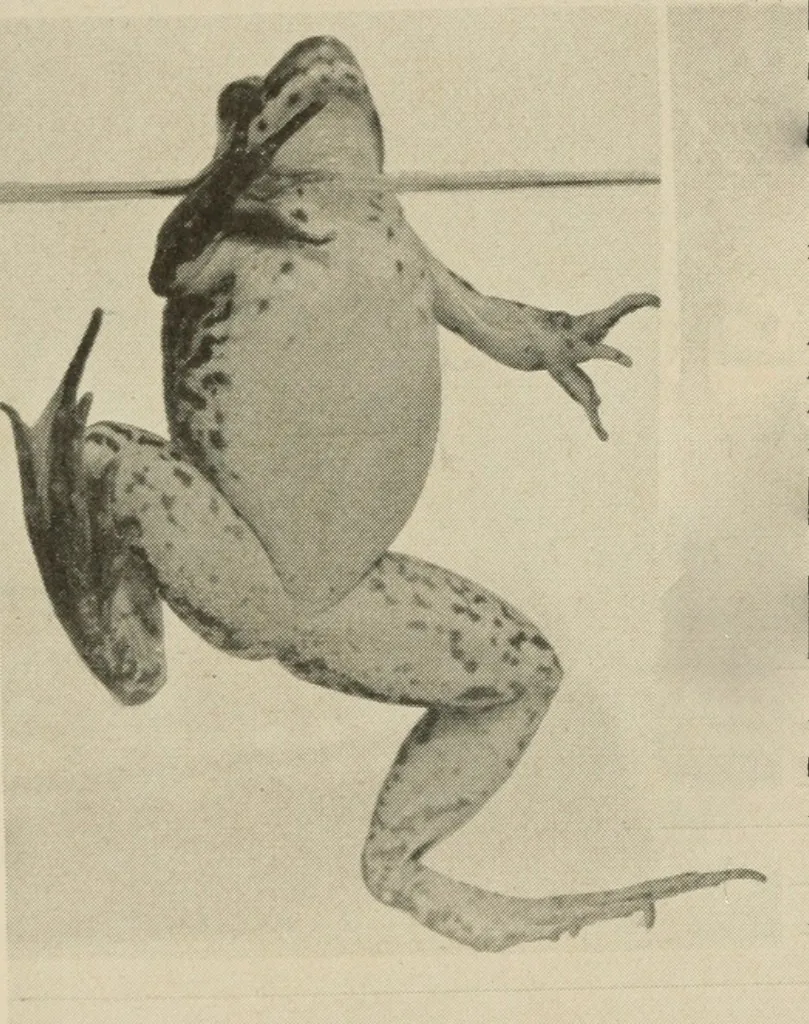
The wood frog's dorsal color varies from pinkish-tan to brown with a very dark brown "mask" through and behind its eyes, fully encompassing the tympanum. The upper lip is lined in white. The dorsolateral fold is colored a light tan with numerous black markings along its length.
The wood frog's call sounds somewhat like a quacking duck. They prefer moist forests and large woods where an intact understory creates a humid microclimate. Like other early spring breeders, wood frogs usually breed in ephemeral (fishless) ponds created by snow melt and spring rains. They have the shortest breeding window of any Wisconsin frog, starting just after frost-out and lasting only about two weeks. Females usually cluster their egg masses together within a pond.
The boreal chorus frog is pale green or tan with three long, broken, and brown stripes running lengthwise along the body. An additional stripe runs from the nostril, through the eye, to the rear legs. Under this stripe is a white line running the length of the lip. The limbs have dark spots or crossbars.
Marshes, wet prairies, river-bottom forests, shrub wetlands and old moist fields are favored habitats. The chorus frog's call resembles the sound produced when running your fingernail over a fine tooth comb. Chorus frogs call from within grassy clumps in water and are nearly impossible to visually locate.
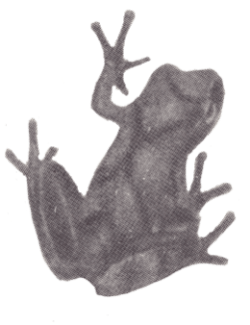
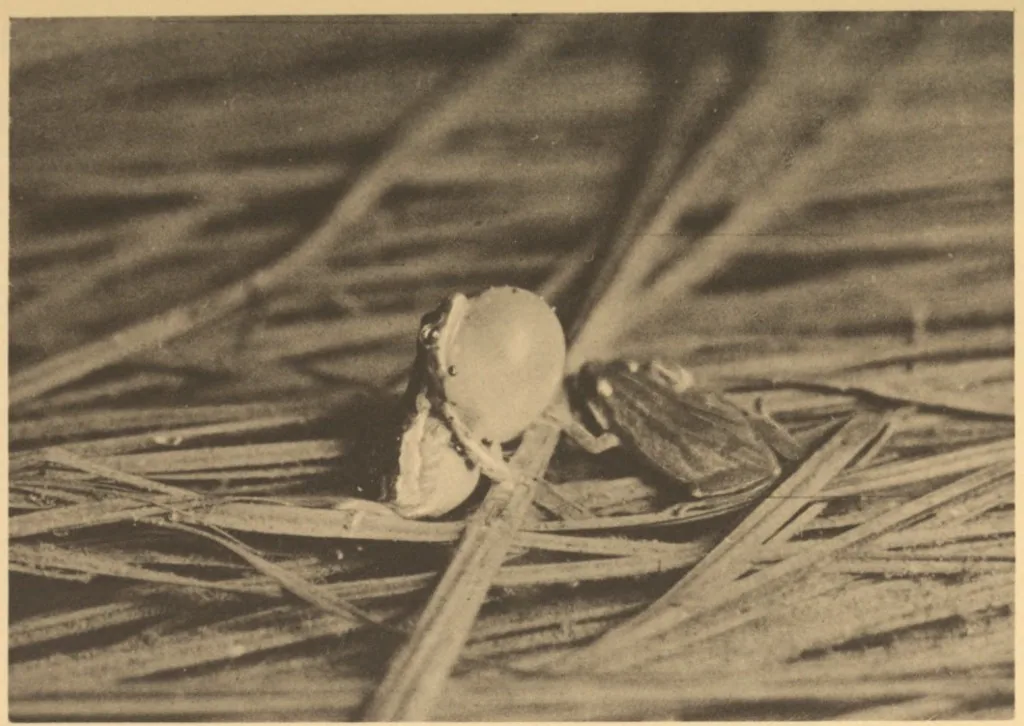
The spring peeper has an irregular dark "X" marking on its light tan to brownish back. They have a dark bar that runs between the eyes and slightly enlarged toe pads that allow them to grip and climb on vertical vegetation.
They are one of the first frogs to begin calling in spring and most successfully reproduce in fishless wetlands. Their call is a very shrill and repetitive "peep." Spring peepers live primarily in moist forests and larger woodlots and breed in wetlands within and adjacent to these habitats. The Wisconsin Frog and Toad Survey shows that this species is still widespread and common.
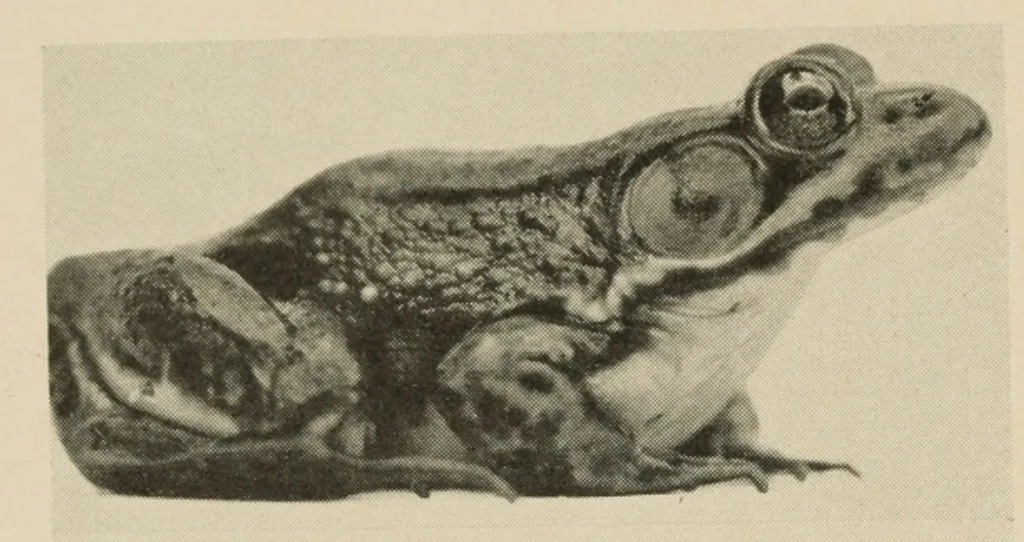
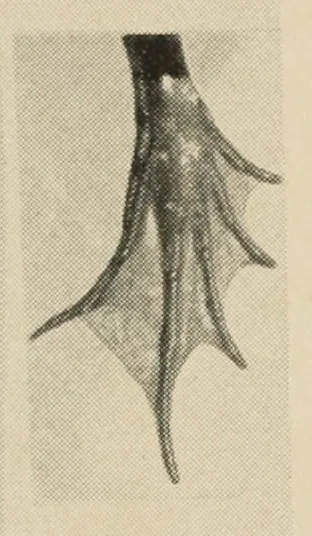
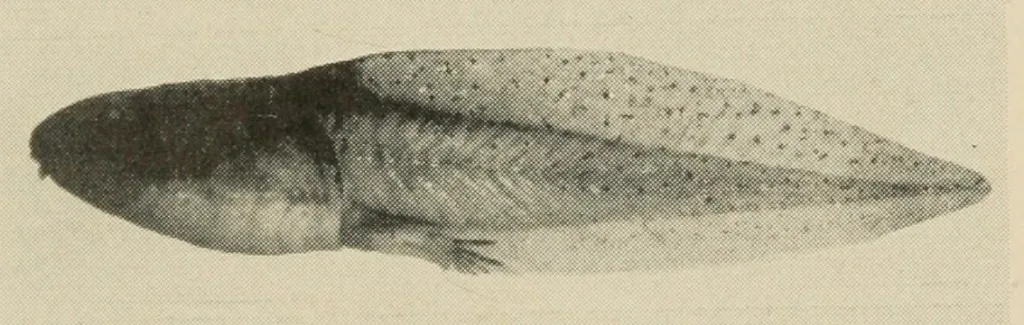
Illustrations: The Frog Book (1906) by Mary C. Dickerson.
The northern leopard frog has a background color of green or light brown with scattered, large rounded brown spots bordered in yellow, especially on spots between the dorsolateral folds. Their ventral side is creamy white without yellow thigh or groin markings.
The leopard frog's call is a loud, broken snore, somewhat like dragging your finger over a well-inflated balloon. They breed in a wide variety of wetlands, especially in fishless waters, and they may forage far from water in old fields and prairies. Northern leopard frogs experienced major die-offs in the early 1970s in the upper Midwest and the decline continues. Scientists have noted that they do not live as long as they once did (about two years versus 3-4 years) and appear to lay far fewer eggs than in the past.
Pickerel Frog (Lithobates palustris), a species of Special Concern in Wisconsin, has a rather complex habitat range as it prefers to overwinter in cold water streams, seepage pools, or spring holes, often taking advantage of water cress for cover. It moves to warmer water ponds to breed and lay eggs from April through mid-June. Adults spend most of the active season foraging on land in riparian habitats along streams and rivers. This species is active from late-March to early-November but can remain semi-active in winter under water. Larvae metamorphose from mid-July to mid-August.
The American toad can easily be identified by its dry rough skin and large swellings behind the eyes (parotoid glands). Its dorsal color can vary from brown to reddish to olive, with scattered dark spots, each encircling one to three wart-like bumps on the back. Their thick skin, which traps body fluids better than most amphibians, allows toads to live greater distances from water than most frogs.
Toads live in a wide variety of habitats ranging from prairies to wetlands to forests. They are somewhat adapted to urban settings where they occasionally persist in gardens and parks. The toad's call is a long, uninterrupted trill lasting up to 30 seconds. Each male has a slightly different pitch. They lay eggs in long strands, unique among Wisconsin's amphibians. Toad tadpoles form schools, also unique among Wisconsin frogs.
The chameleon-like gray treefrog changes color with temperature or substrate color. Their background color varies from gray to green with blackish mottling. Unlike the Cope's gray treefrog, gray treefrogs do not lose their mottling when warm, although it may fade. In all cases, gray treefrogs have a white spot below each eye and bright yellow inner thigh markings.
Toe pads are pronounced and serve as suction cups to cling to various surfaces. Their call is more melodic than the Cope's. This species will call beyond the breeding season, especially on warm, rainy or humid days. Gray treefrogs are forest and large woodlot dwellers and breed in semi-permanent to permanent wetlands.
Although smaller and slightly smoother-skinned than the gray treefrog, the Cope's gray treefrog can be tough to distinguish from this close cousin, especially during the breeding season when both are usually heavily mottled on the dorsal (top) side. However, the Cope's gray treefrog is often a solid lime green on the back during the non-breeding season.
Cope's gray treefrogs, like the gray treefrogs, have bright yellow inner thigh markings when viewed from the underside or laterally when the legs are extended and have obvious toe pads. They can most easily be distinguished from the gray treefrog during the breeding season by their call, which is short and raspy. Cope's lives primarily along forest or woodlot edges and in oak savanna, favoring brush over trees.
Blanchard's Cricket Frog (Acris blanchardi), listed as Endangered in Wisconsin, prefers ponds, lakes, and a variety of habitats along and adjacent to streams and rivers including marshes, fens, sedge meadows, low prairies, and exposed mud flats. This species may breed in no or low-flow areas of streams and rivers but primarily breeds in adjacent ponds, lakes, and wetlands. Cricket frogs cannot tolerate prolonged exposures to freezing or submersion during the winter, therefore seek a variety of microhabitats that provide suitable overwintering conditions, including crayfish burrows, small mammal burrows, rotted-out root channels, seepage areas where groundwater flow prevents freezing at the surface or spaces created by sloughing stream banks. Cricket frogs are active from early-March through November. Breeding can occur from mid-May through mid-August, with some larvae not transforming until late-September. See the species guidance document for avoidance measures and management guidance from the Natural Heritage Conservation Program.
Mink Frog (Lithobates septentrionalis), a species of Special Concern, prefers rivers and lakes with bog shoreline habitats. They are a shoreline-dependent species but also forage on and around floating mats of vegetation in the littoral zone. They may sometimes be found in permanent waters where no bog characteristics exist, but they are usually associated with tannin-stained waters. Mink frogs overwinter in water to avoid freezing. They are active from April through October and breed in June and July. Larvae overwinter before transforming the following summer.
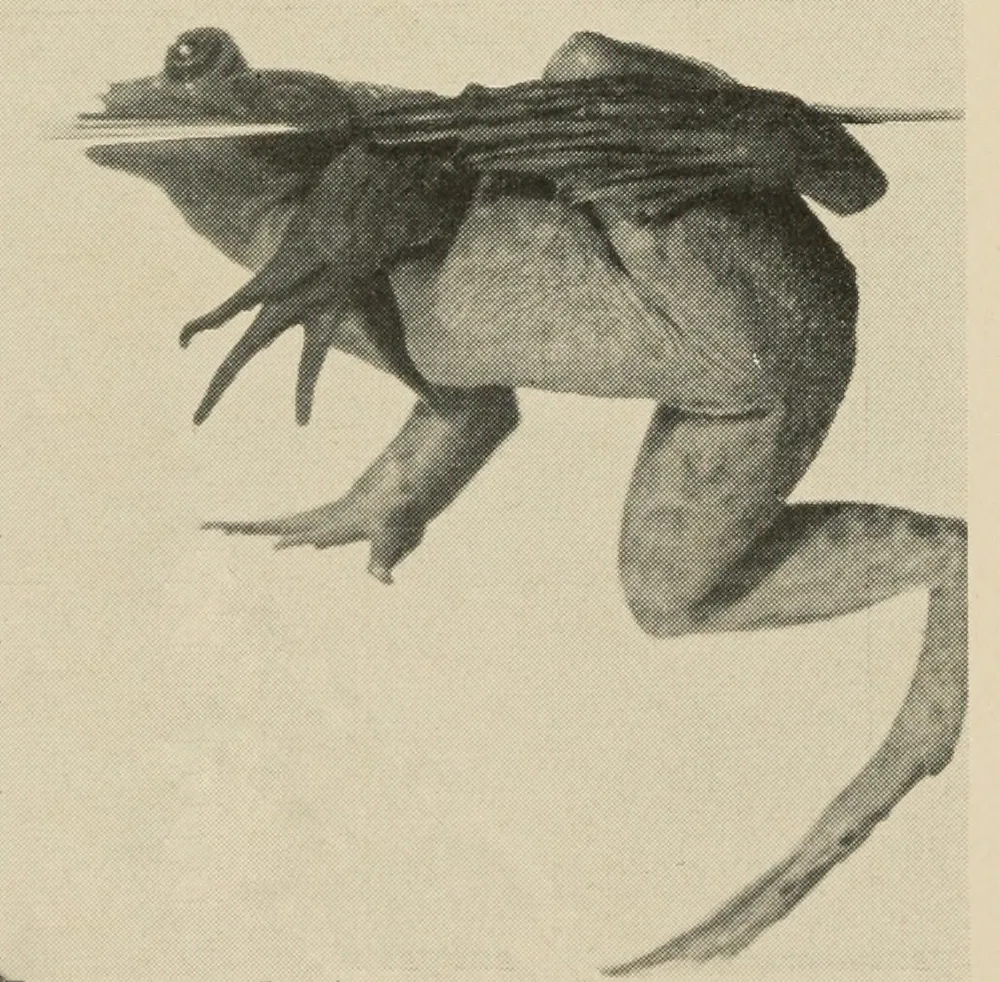
Green frogs have a light to dark olive green or brown background color with small, irregular dark brown spots. Spots are often more numerous in juveniles. They have prominent dorsolateral folds that run from behind the eye to about mid-body.
Like American bullfrogs, adult male green frogs have bright yellow chins. Their calls are low "gung-gung-gung" - like strumming on a loose banjo string. Eggs are laid in a mass attached to floating vegetation on the water's surface. Because their young often overwinter as tadpoles, green frogs require permanent water, like deep marshes, large ponds and lakes. Recent studies show that heavy shoreline development significantly reduces populations, primarily because of lost natural shoreline vegetation.
The bullfrog can range from a dark solid olive to a lighter pale green with variable spotting. They have a distinct tympanic fold that wraps around the tympanum (ear membrane). Adult males often have bright yellow chins during the breeding season and their tympanum is twice as big as the eye. The female's tympanum is about the size of the eye.
Wisconsin DNR Herp Atlas: Report amphibian sightings at wiatri.net/inventory/mpherp. Your observations help track population trends and inform conservation management across the state.